The following article was part of the the Newham Deanery News 2026 Edition Magazine.
A Lecture with Arise | Parish Good News
Arise: Faith, Science & Human Dignity Explored | Parish Good News
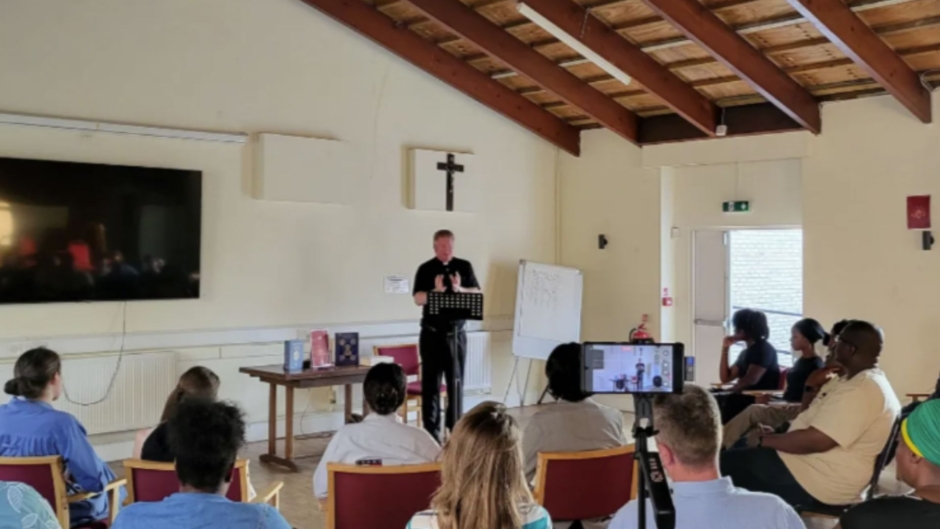
An audience gathered on the evening of Friday 17th July for a thought-provoking lecture that examined one of the most pressing questions of the modern age: just because science allows something, does it mean it should be done?
Father Daniel Kelly, a Catholic priest and trained bioethicist, delivered a wide ranging talk that moved between theology, philosophy and contemporary medicine with clarity and precision. Speaking to a full room at 7:30pm, he invited listeners to reflect on the dignity of human life from its earliest beginnings to its natural end.
At the centre of the evening was a principle rooted in Christian teaching: that every human being is created in the image of God. From this, Father Daniel argued, flows an intrinsic dignity that is not dependent on health, ability, intelligence or social worth. Whether unborn, elderly, disabled or terminally ill, each life carries equal value.
He warned against allowing scientific profess to outpace moral reflection. Human dominion over the world, he said, must not become domination. Scientific knowledge is a gift, but one that must remain guided by conscience.
Drawing on the philosophical traditions of Socrates, Plato, Aristotle and Thomas Aquinas, Father Daniel described education as a process of drawing out truth rather than simply delivery information. The lecture itself reflected this approach, posing difficult questions rather than offering simplistic answers.
He stressed that faith and reason are not in conflict. Instead, they must work together. Faith without reason risks becoming blind, while science without ethical grounding can become dangerous.
The discussion turned to marriage, procreation and modern reproductive technologies. Within Catholic teaching, he explained, marriage holds both a unitive and procreative purpose. While acknowledging the deep suffering of couples facing infertility, Father Daniel outlined ethical concerns surrounding in vitro fertilisation, particularly the creation and storage of multiple embryos.
He was careful to emphasise that children conceived through IVF possess the same dignity as any other child. The concern lies not with the child, but with the processes that may involve the destruction, selection or indefinite freezing of embryonic life.
This theme continued in a discussion of stem cell research and genetic technology. Father Daniel distinguished between ethically acceptable sources of stem cells, such as adult or umbilical cord cells, and research that involves the deliberate destruction of embryos.
He also warned against the emerging possibility of genetic selection. Medicine, he argued, should aim to heal rather than to design preferred forms of humanity. A society that begins to favour certain traits risks turning unconditional human worth into something conditional.
The lecture addressed abortion with clarity, presenting the Catholic position that direct abortion is morally wrong because it intentionally ends a human life. At the same time, he noted the complexity of medical situations in which treatment may unintentionally result in the loss of a child, highlighting the importance of intention in ethical decision making.
A particularly powerful section of the evening focused on disability. Father Daniel rejected the idea that physical or cognitive limitations reduce a person’s value. Instead, he suggested that the presence of disability calls society towards greater compassion and solidarity.
On end of life care, he spoke in support of organ donation as an act of generosity, provided that proper consent and clear determination of death are ensured. He expressed concern about assisted dying, arguing that is may place subtle pressure on vulnerable individuals who fear becoming a burden.
True compassion, he suggested, lies not in ending life but in accompanying those who suffer. Palliative care, effective pain management and human presence were presented as essential responses.
In his closing remarks, Father Daniel used the biblical images of the Tower of Babel and the rebuilding of Jerusalem to illustrate two paths for human progress. One, driven by ambition alone, risks collapse. The other, guided by moral purpose, offers hope and stability.
The evening concluded with a lively question sessions covering topics from genetic engineering to conscientious objection in medicine. While few issues were resolved indefinitely, the lecture succeeded in prompting deeper reflection.
Attendees left with a renewed awareness that scientific advancement, while powerful, must remain rooted in respect for human dignity. As Father Daniel made clear, progress achieves its fullest meaning only when it serves the value of every human life.
To read the other articles in the Newham Deanery News magazine, click here<<
You can watch a recording of the lecture from the Arise YouTube channel below